
Why Canada Is One of the Hardest Countries in the World to Travel Across
Presented in partnership with Flightpath.

Why Canada Is One of the Hardest Countries in the World to Travel Across
At first glance, travelling across Canada doesn’t seem complicated.
It’s one country. One language (mostly). One currency. No borders to cross.
But once you actually try to plan a trip—from one region to another, or even between mid-sized cities—you start to realize something quickly:
Getting across Canada isn’t just travel. It’s logistics.
What looks simple on a map often turns into a long, multi-step journey shaped by distance, infrastructure, geography, and timing. And compared to many other developed countries, the difference is noticeable.
Here’s why.
It Looks Manageable—Until You Zoom Out
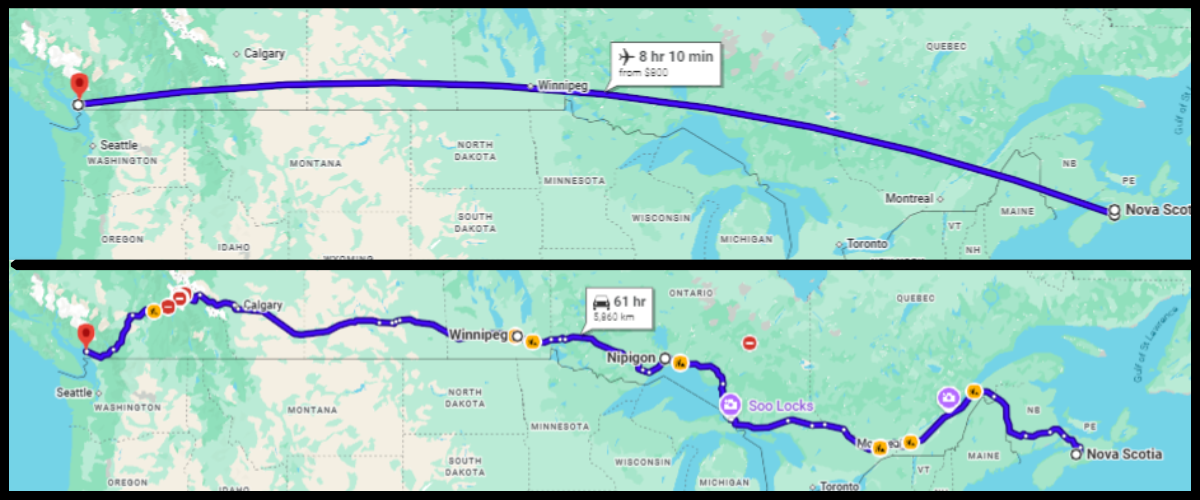
Canada is the second-largest country in the world, covering nearly 10 million square kilometres, but that fact doesn’t really land until you try to move across it.
Nova Scotia to Vancouver isn’t just a domestic flight—it’s a cross-continental journey. Toronto to Calgary can take as long as flying between entirely different regions of Europe.
Driving isn’t always a solution either. What might be a reasonable road trip in other countries can mean days behind the wheel here.
Distance in Canada isn’t just big—it behaves differently.
Canada Isn’t Just Big—It’s Spread Out in a Unique Way
Yes, Canada is massive. But size alone doesn’t explain the challenge.
What makes Canada different is how its population is distributed.
Most Canadians live within a narrow band along the southern border, while outside of that corridor, communities become smaller, more remote, and more widely spaced. This creates a kind of imbalance, where a few highly connected urban centres are surrounded by large areas with limited transportation options.
In countries with more evenly distributed populations, travel networks tend to be denser and more flexible. In Canada, the system has to stretch across long distances with fewer “in-between” stops, and that changes everything about how you move.
Direct Routes Are the Exception, Not the Rule
If you’re travelling between major cities like Toronto, Vancouver, or Montreal, things are relatively straightforward.
But the moment your trip involves smaller or mid-sized cities, the experience shifts.
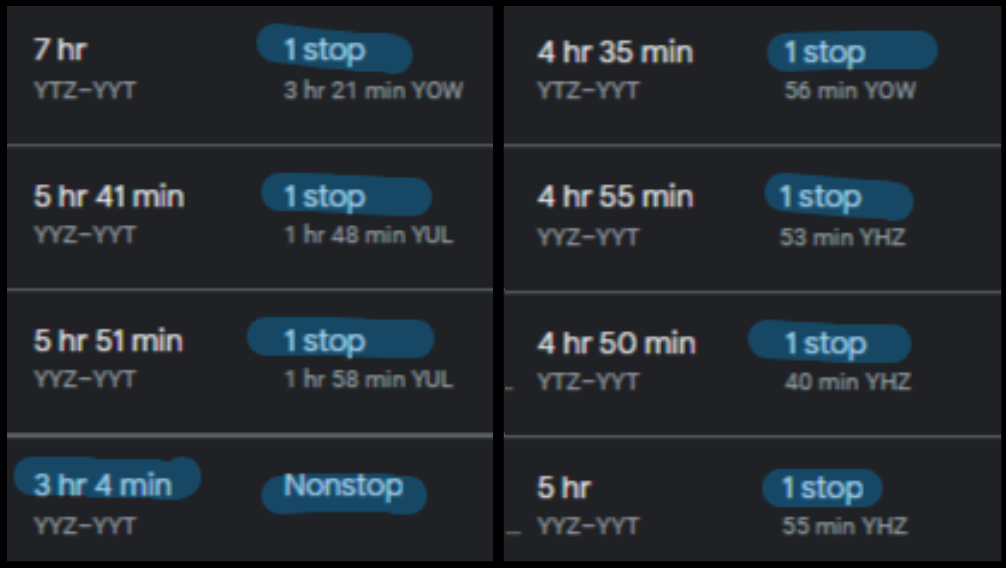
Instead of flying directly from Point A to Point B, you’re often routed through a major hub, even if that means going out of your way. A trip that might be a straight line geographically becomes a sequence of departure, connection through a major airport, a layover, and then continuation to the final destination.
Sometimes that adds hours, and sometimes it adds an entire day. It’s not inefficient by accident—it’s simply how the system is built.
A Few Major Airports Carry a Country-Sized Workload
Canada’s air travel network depends heavily on a small number of major airports, including Toronto Pearson, Vancouver International, Montreal-Trudeau, and Calgary International.
These hubs are essential because they connect Canada internally and to the rest of the world. However, they also create a funnel effect. When most routes pass through the same few points, travel becomes more centralized, more indirect, and more sensitive to delays.
If something slows down at a major hub, the impact can ripple across the entire network.
Geography Isn’t Just Scenic—It’s a Real Constraint
Canada’s landscape is one of its greatest strengths—and one of its biggest travel challenges.
Infrastructure must work around major physical features such as the Rocky Mountains in the west, vast forests and lakes across central Canada, remote northern regions with limited road access, and coastal areas affected by marine weather.
In many parts of the country, building and maintaining transportation routes is expensive, complex, or simply impractical. That’s why air travel isn’t just common in Canada—it’s essential.
Weather Adds a Layer You Can’t Plan Around
Even the best-designed travel system has to deal with Canadian weather.
Depending on where you are in the country, that can mean snowstorms and ice in winter, fog and wind along coastal regions, or rapid seasonal changes that affect visibility and safety.
Unlike some parts of the world where weather disruptions are occasional, in Canada they are part of the equation. Travel doesn’t stop, but it does require more flexibility and patience.
Time Becomes the Real Cost of Travel
When people think about travel, they often think in terms of distance.
In Canada, the more important factor is time.
This includes not just time spent in the air, but also time spent connecting between flights, waiting at airports, and dealing with delays or rerouting. A trip that appears short on a map can easily take up most of your day once these factors are considered.
Over time, this reality changes how people approach travel altogether.
Why This Matters More Than People Think
For casual travellers, these challenges can be frustrating.
For businesses and industries, they can be limiting.
Across Canada, many sectors rely on the ability to move people quickly between locations, including construction and infrastructure projects, natural resource industries like mining and energy, healthcare and specialized services, as well as professional services that operate across multiple regions.
When travel takes longer, becomes less predictable, or requires multiple steps, it affects productivity, scheduling, and decision-making. In some cases, it even influences where and how companies choose to operate.
The Quiet Role of Alternative Travel Solutions
Because of these challenges, Canada has developed something that many people don’t see: a parallel layer of travel.
Beyond commercial airlines, there are alternative ways of moving across the country, particularly for time-sensitive or region-specific travel.
One example is private charter flights across Canada, which allow travellers to fly directly between smaller or regional airports, avoid congestion at major hubs, and complete multi-city trips within a single day.
For many businesses, this approach isn’t about luxury—it’s about solving a logistical problem that the standard system isn’t designed to handle. It’s one of several ways Canadians have adapted to a country where distance and access don’t always align neatly.
Travelling in Canada Requires a Different Mindset
In more compact or densely connected countries, travel is often straightforward.
You pick a destination, choose a route, and go.
In Canada, the process is more layered.
Travellers start thinking about how many connections are involved, how reliable the route is, how much extra time they need to build in, and what alternatives are available if plans change.
It becomes less about asking “How far is it?” and more about understanding what it will actually take to get there.
A Country That Redefines Distance
Canada has a way of shifting your perspective.
What counts as “far” here would cross multiple borders elsewhere. What feels like a routine travel day can involve multiple flights, long connections, and changing conditions.
And yet, for Canadians, this is normal.
It’s part of living in a country defined by space, scale, and separation between places.
So Why Is Canada So Hard to Travel Across?
Because everything that defines the country—its size, geography, population distribution, and climate—also defines how people move through it.
There’s no single issue to fix, and no simple solution.
It’s simply the reality of a country built on vast distances and complex terrain.
Final Thoughts
Travelling across Canada isn’t difficult because the system is broken.
It’s difficult because the country is different.
And once you understand that, the experience starts to make more sense—even if it still takes a little longer than you expected.